I’ve finally done the thing. I pushed through my concerns about a stigma of solo play that I had in my head, a stigma other would-be solo players I know share, and finally tried out solo play of an RPG.
I’m glad I did.
I’ve played or run D&D in a variety of formats. There’s the assumed-default of playing with friends around a table with a couple character sheets and imagination. I’ve run some games that way. I’ve been on either side of the screen at tables with props, gizmos, and too many computers for my taste. I’ve run games using virtual tabletops online. I’ve even run asynchronous play-by-post online. Despite having found there to be many acceptable ways to play TTRPGs, something about playing them by myself always felt like a wrong way.
I think the big hang-up was this notion that TTRPGs, whether in-person or online, with tools or without, is supposed to be a social experience. Against that mindset, solo play comes with this idea that I’m giving up on having friends to play with at a table or that I’m somehow going to just isolate myself by engaging in solo play. Neither of these things are (intrinsically or necessarily) true, but the concern kept me from trying solo play for a couple years now.
I’ve spent longer on this part of the post than I planned to, but it seems a common enough issue that I didn’t want to deny how potent that worry is. Ultimately, I reasoned that I already partake in solo activities, including solo gaming (even solo board gaming!), and it was silly to rule this out as something that could go in that category of solo activities; not as a replacement for time spent with people but as something that could be done instead of booting up a video game.
Hooboy. I’m now a believer. I think I’ll start working on logging solo sessions here. With that in mind, I’ll use the rest of this post to talk about why I like this solo gaming so much rather than get into the content of my solo play.
First up, setup. I needed to settle on a system. ShadowDark is where I settled. I enjoyed running it before, and it’s what I think I want to make my TTRPG home going forward. Seemed a good choice for solo play too. The simple and accessible SoloDark PDF made it an easy onramp for solo play as well.
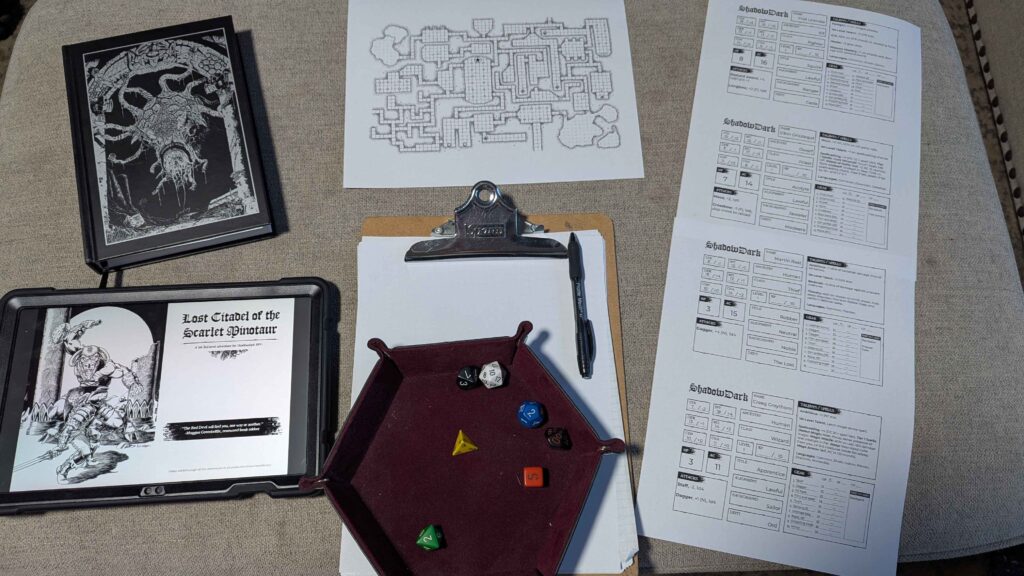
Next, I opted to start on a pre-written dungeon rather than going straight into full procedural generation or intentionally-designed homebrew. So, I went with the Lost Citadel of the Scarlet Minotaur adventure from ShadowDark’s freely available Quick Start Rules. I also used the pregen character sheets that came with it. I think I can safely recommend this as a good way to start solo play.
Finally, I got my dice, the core rulebook, a notebook, printouts, and a spot to put everything. I’m not sure I need this setup every time (and it was indeed a little different in my second session of play), but having everything in front of me made it easy to know I wasn’t going to have to get up every five minutes to find something I forgot.
Eventually, it was finally time to roll dice. Usually, when running a pre-written adventure, I’ll make sure to know the adventure pretty well. This time, I tried not to read everything that was going on so I could be surprised. This was probably the hardest part of solo play (with something already written), but it worked out well enough by getting into my characters. Basically, I decided what each character would naturally do upon entering a room and how they would react to things. Committing to roleplay in this way definitely cost the party dearly, but it made it possible to juggle what I know as the GM and what the characters know in their finite knowledge.
So, the thief naturally looks for loot opportunities. The fighter and ranger look for threats. The wizard looks for insights from the room. If the room description has something, the relevant character would make an INT or WIS check to see if they spot it. If that something is living rather than inanimate, I might utilize SoloDark’s basic Oracle to determine whether that living thing made the first move. Either way, with the application of a little GM’s intuition and common sense, it turned out to be pretty easy to run both sides of the screen in solo play.
That is, until roleplay requires making bad decisions. Right away, the party finds a hostile creature that ran away and laid an ambush. Chasing a hostile down a corridor is a bad idea, but the nature of the fighter was to argue that a known enemy they chase is better than that same enemy later stalking them. True to ShadowDark, this led to a downed (but fortunately stabilized!) character and almost a TPK.
Despite playing both sides of the combat, it quickly felt exciting and like combat should. I didn’t expect to have this much fun with it, but I sure was having fun with it.
Back to the player side of things, I pulled my party out of the dungeon in hope of recovery. Again, it’s ShadowDark, so that doesn’t guarantee safety! Thanks to having to look a few things up to make sure I was playing ShadowDark and not 5e, I decided to call it there for my first session, but I was already looking forward to playing more.
A few days later, I was thinking about my game. I was too tired to pull out all my materials and go for a full session, but it dawned on me that one of the beauties of solo play is that I didn’t need a full session to do stuff. And this, it turned out, to be a brightly shining part of solo play: Even ten minutes spent on the game can be productive time for the game.
In that ten minutes at my desk, I performed Oracle rolls to find out that there was a town close enough to have the party drag their unconscious member back to the inn for rest. I researched living expenses in ShadowDark, found they’re not part of the core rulebook, and simply co-opted the basic table from 5e for this. I then did bookkeeping to get the party healed up, paid up for the inn, and stocked back up on torches.
Ten minutes. That’s all I spent with a couple dice and my session note pad. It’s all I had the time and energy for, but it was enough to make meaningful progress and setup for the next time I had a longer game session.
Compared to traditional group play, I would have spent that time researching or making design decisions, written it down, waited two weeks (or two months!) for the next game session, and then had to find my notes on the decision, then had the players role play it out (if fitting) and do all their bookkeeping, cutting into precious session time. That’s part of the game (or part of the game I mitigate by doing 1:1 stuff with players between sessions then simply have them recap when we’re back at the table), but in solo play, all of that was actually playing the game.
Huge fan. Highly recommend.
When I went back for another dungeoneering session, it didn’t feel like “solo play” anymore; it just felt like play.
This post has already ran long, but I don’t really want to cut anything out of it. I’ll be back again in the future with more thoughts on solo play, separate from solo session recaps that I’ll also work on. One of the big topics I’ll aim to hit is pre-written content vs. procedural generation since I think that’s going to be a big deal for me.
Until next time!
Awesome read, love to see that you had fun with your first solo session! Now I’m gonna dig around a bit to see if you continued…
Sounds amazing. Wonderful write up.
Did it cause you to feel schizophrenic having to be in the shoes of characters, npc, monsters and the dungeon itself? Or does the solo play have some kind of automa system that does most the lifting?
I may have to peek at this free pdf starter kit for ShadowDark!