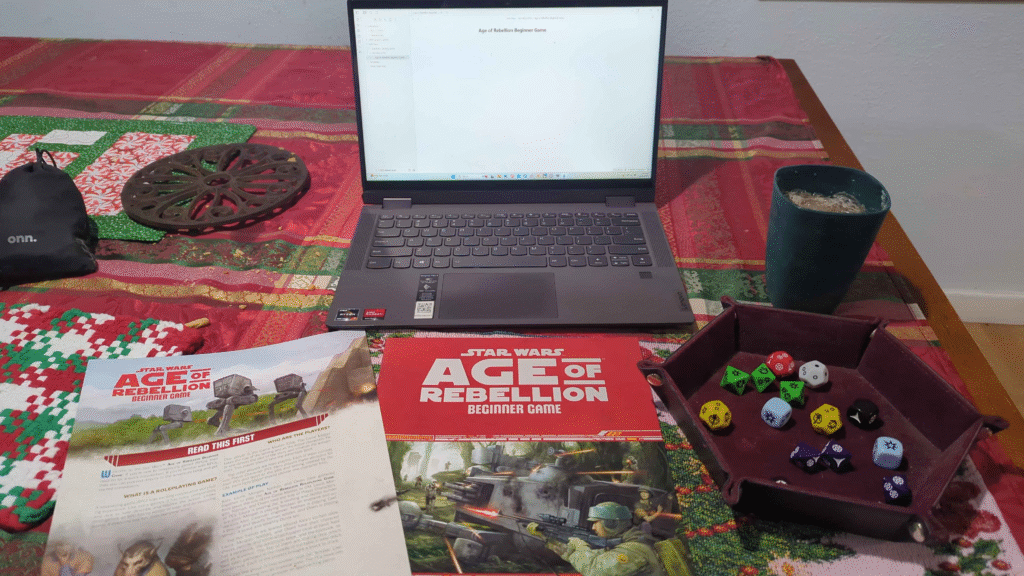
Over the Christmas break, I finally got out the Star Wars: Age of Rebellion Beginner Game and took its adventure on a solo play run. I love Star Wars. At the time, I was wrapping up a read of Stackpole’s X-Wing: Wedge’s Gamble. I also really like Genesys, having run a play-by-post in the Android setting for a while. The FFG/Edge Studio Star Wars game seems like an easy win for someone like me, but I simply haven’t gotten a group together to play it.
So, I decided to take a similar approach to trying it out as I did with ShadowDark’s Lost Citadel of the Scarlet Minotaur adventure, which is to say solo playing through a pre-written adventure, taking on the roles of both GM and PC with minimal use of oracles or other rolltables and determiners since most of the intended outcomes are already in the adventure.
For this posting, I want to focus on three things: My opinion of the adventure/box set as a product, my opinion of the system/rules as presented in the beginner game, and my experience in playing it solo.
So, starting with the adventure, this largely felt like it did a good job capturing the feel of a small group of ground forces going on a high-risk mission. Could have just as easily been a Rogue Squadron outing. There’s a generally good mix of encounter types, allowing to talk or trick your way through problems instead of going straight to blasting, even if blasting is inevitable in a lot of cases.
The size of the adventure feels about right for this kind of product. I think I spent a total of four hours across two nights playing the game, and a good bit of that was getting the system refresher and making sure I was doing things the Star Wars way instead of the Genesys way. (Not that there’s a lot of difference.) The biggest slog was a result of solo play and juggling multiple character sheets. I’d say in a full group with GM, it’s probably 3-4 hours of play unless there is a lot of rules confusion or optional exploration taking place.
Regarding the product as a box set, buying a beginner game should be a no-brainer for someone wanting to get into this Star Wars RPG. Assuming you can find them at standard retail, the box sets are something in the range of ten dollars more than a dice set alone. The box set comes with a full set of the Star Wars narrative dice, nice character sheets (that teach you how to use them), play mat, cardboard tokens, and, of course, the introductory adventure and a short version of your chosen flavor’s rulebook. For solo play, I stuck to theater of mind and didn’t use the map/tokens, but I’ve definitely set them aside for future group play. The material quality of all components is solid.
My complaints about this product are a good transition point into my opinions about the rules. Before the end of the adventure is a mandatory vehicular chase sequence. However, despite vehicle rules existing in the rulebook portion of the product, the adventure tells you “treat this encounter the same as your on-foot combat encounters.” It’s probably not the most reasonable thing to assume vehicular wargaming rules will be utilized in a narrative-focused role-playing game, nevermind that Asmodee already has separate games for that. But the included rulebook does have vehicular rules and throwing them out the window in the name of further simplification robs the encounter of feel in a system that otherwise gets the Star Wars feel right.
And despite that complaint, I do think that Age of Rebellion does a good job of capturing the feel of Star Wars. This really comes back to the narrative dice and the way it adds qualities of success/failure as well as a second dimension of “and/but” that applies to any given roll. If you’re unfamiliar with the game or Genesys, this means you can really stick the landing on an attempted skill check but still alert some nearby Stormtroopers to your presence. Or you can very much miss shooting that Stormtrooper but your wide-firing shot managed to hit an access panel that locks out further reinforcements.
This Star Wars RPG is a dice pool game, where you build your pool based on a combination of character and environmental factors. If your only experience with RPGs is d20 systems, it will take some adjustment to get going with SWRPG/narrative dice, but I really do like the system. It actually works really well, and is thoughtfully designed, once you change your mental approach. In fact, the system is pretty solid for combat and non-combat activity alike.
Of course, I’m trying to give attention to the rules as presented in this box set, and I will commend their success in the “learn as you play” approach. The first half of the adventure is very much on rails, guiding players from one encounter to the next, but this is done so that each encounter comes with its share of new rules to introduce. This is meant to teach players and GMs alike since playing as presented means the GMs aren’t supposed to use the separate rulebook until after running the adventure.
But the adventure book in conjunction with the character sheets actually does a good job of walking through the basic forms of these mechanics. At the mid-point of the adventure, the rails become a little more optional, giving opportunity for base exploration (with rewards for doing so!) and giving player choice in how they want to pursue advancement.
Oh, and SWRPG doesn’t do level-based advancement. Rather, you burn XP on acquiring/upgrading skills and such as you see fit. This offers a lot of flexibility in how you want to shape your character as you play. You also don’t have to wait to hit specific level-up points if you’re regularly gaining and spending your XP.
I’m already running long, so I’ll summarize with this: Age of Rebellion’s rules work really well, even in this shortened form of the rules for the beginner game. It’s clearly a simplified version of the game with limited options, but the presentation of the rules does work well as an introduction. Come with an open mind and be ready to check “what does that symbol on the die mean” a few times (conveniently printed right on the character sheet!), and I think you should be good to go. The system does lend itself to feeling like you’re running a Rogue Squadron ground op.
That leaves me to my final consideration for this post: How does it work as a solo game? With regard to the box set, it kind of does. The adventure doesn’t leave a lot of room for roll tables or oracles, but it does work fairly well as a choose your own adventure game similar to what Paizo offers in its Pathfinder and Starfinder sets.
Some things I’d definitely recommend if you’re wanting to try to box as a solo outing: Don’t bother with the map and tokens. You’re probably not going to be playing too tactically in these encounters to where it’s worth taking up space on the table for what’s easily tracked with simple note paper (or just keeping track in your head). These resources would be good in a group game, or perhaps other solo play endeavors, but you’re better off keeping that space available for laying out the adventure book and character folios.
And on that note, you might want to check the official websites for printable versions of the character sheets that give you just the sheet (without the helps) on a single piece of paper. The helps are great for learning the game, but when you’re one person running four characters, you only need the helps once. If you have the ability to get the sheets as single pieces of paper, the simplification of space demands will help a lot.
But getting back to the game and playing it solo, the beginner game work well enough because the scripted encounters give you plenty of possible (and probable) ways to approach the given problem. Looking beyond the included adventure and to further solo play (with or without the core rulebook), it’s a little harder to say. There’s no reason procedure- and oracle-driven play is off the table with Star Wars or Genesys (Parts Per Million has a Solo book for Genesys already), but the license probably means you’re going to have to find quality fan-made oracles or apply your own Star Wars flavoring to oracles from other systems.
Of course, if you have a general idea for an adventure you want to pursue and enough general Star Wars knowledge to do it, simple oracles like those provided in SoloDark will get you where you want to be. You just might need to do a little more legwork (either in doing the previously mentioned search for fan oracles or filling in your details yourself) than you might in a differently-licensed product. That said, the narrative dice mechanics, the qualities and varieties of successes and failures, would actually lend themselves well to solo play in this fashion if that’s what you’re looking for.
I have the three main core books for Star Wars RPG and their corresponding beginner games. (Again, if you want multiple sets of dice, you may as well buy the box sets for the extra assets.) I definitely want to take Edge of the Empire and Force and Destiny’s respective games out for a spin, but I’ll probably try solo playing one of the other games on my shelf first.
Until then!
Awesome stuff dude. The biggest complaint I have with the beginner sets is that the premade PCs do not follow the rules of either character generation or character advancement in the the core game. I believe the one PC from Edge of the Empire gains an ability that is not on the advancement tree.
Thanks! And good share on your complaint! I wasn’t looking closely enough at that disconnect and didn’t catch it. I knew they did a number on vehicle details and should have figured the same would be true for PCs. Alas.